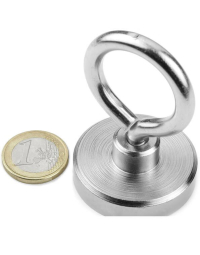
Magnetic fishing is becoming more and more popular as people become familiar with the concept. This can be seen on YouTube, where more video guides on magnet fishing are being uploaded. Incidents of people fishing weapons and hand grenades out of lakes have also provided the media with material for video reports and news articles about the new trend of people fishing with magnets.
What is magnet fishing?
Magnet fishing is not about catching fish, but about finding things at the bottom of lakes, rivers and harbours using powerful magnets. It's actually quite simple: You take a powerful magnet, tie it to a long rope and throw the magnet into the water. Then you pull the magnet back in and, if you're lucky, it will have stuck to something containing iron along the way. It could be an old bicycle, weapons from World War 2. World War II weapons, fishing tackle, historical artefacts and anything else that has been thrown into the water over the years.
Is magnet fishing legal?
I am not aware of any legislation that allows or prohibits magnet fishing. Until that happens, you have to rely on common sense. That is to say:
- Avoid magnet fishing in places where you can damage the environment or harm other people. For example, a marina on a Sunday summer afternoon.
- Avoid magnet fishing on private property unless you have permission from the property owner. Also agree on who owns what is being fished up.
- Avoid fishing in places where nature can be damaged. Remember that the magnet can damage the lake bottom and/or damage the lake's plants.
Remember to clean up after yourself. If you catch an old rusty bike that you don't want to keep, make sure you dispose of it properly anyway. If magnet fishing is to be possible in Denmark in the future, it's important that people think positively about the discipline as well as the practitioner.
What do I need to get started with magnet fishing?
To get started, you need two things: A magnet and a rope.
Choosing a magnet
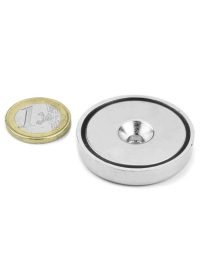
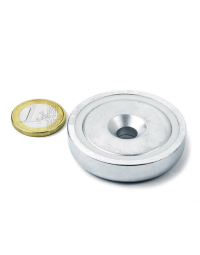
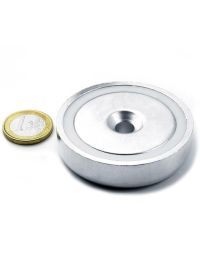
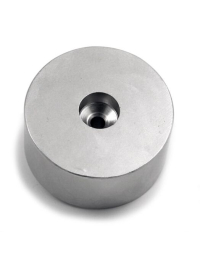
It must be possible to attach a rope to the magnet. So either the magnet must have a hook/eye or it must have a hole in the centre for the rope to pass through. Magnets with a hook eye are often called pot magnets because the magnet is encased in a steel casing. The casing increases the magnet's strength and provides good protection against shocks and impacts that can otherwise damage the magnet. The magnet with a hole in the centre is called a ring magnet. It has no steel casing and is therefore not protected against shocks and impacts. However, it is magnetic on all sides. The pot magnet is only magnetic on the underside as the steel casing shields the magnetism on the other sides. We can list the advantages and disadvantages of the two types of magnets as follows:
- Advantages of the pot magnet
- The magnet is stronger than a similarly sized magnet without a steel casing.
- The magnet is protected against shocks and impacts on all sides except the bottom.
- Tying a rope is easy as the pot magnet typically comes with a hook or hook eye.
- Disadvantages of pot magnets
- They are not intended to be in contact with water, so the pot is likely to rust.
- For a pot magnet to perform at 100%, it must make full contact with the iron surface you want to capture. It's difficult to achieve full contact on a bicycle frame (which is round), but easy to achieve full contact on a car roof, which is flat.
- Advantages of the regular magnet
- The regular magnet is cheaper and is magnetic on all sides.
- Disadvantages of a regular magnet
- Because the regular magnet does not have a steel casing, it is more prone to shocks and impacts that can damage the magnet.
- The regular magnet doesn't have a hook or hook eye, which you need to choose a magnet that can be tied with a rope, such as a ring magnet.
It should also be mentioned that there are two common types of magnets: neodymium magnets and ferrite magnets. Most people choose neodymium magnets for magnet fishing because they have a very high strength compared to ferrite magnets. However, neodymium magnets need to be handled with care as the material cannot withstand hard knocks or humid environments. So make sure to keep your neodymium magnet clean and dry when not in use. This also applies to the neodymium magnets that Brisingi sells, as they are not produced specifically for magnet fishing and therefore also have the problems mentioned.
How strong does the magnet need to be?
On each product page, we write a number that tells you how many kg a magnet can lift. If you test a magnet, you'll find that the number of kilograms we state is actually the number of kilograms the magnet can hold. But when it comes to magnet fishing, there are a few things to keep in mind:
- The magnet, and especially pot magnets, need full contact with the surface to work best.
- Over time, the magnet can pick up dirt such as small pieces of iron. If you don't remove the dirt, it will form a layer that prevents the magnet from making full contact with the object you want to lift. So make sure you keep the magnet clean.
- Slippery surfaces can cause the magnet to slip off. So heavy metal covered in algae can require a powerful magnet to lift.
- When lifting something from the bottom of the lake, take into account that the water will provide resistance when you lift and that the magnet must also support the weight of the rope.
As a rule of thumb, you can therefore expect a magnet to lift somewhere between 10 and 20 per cent of the strength/adhesive force indicated by the magnet.
Choosing a rope
Rope selection is somewhat simpler than magnet selection. You need to choose a rope that has a breaking strength that is higher than the strength of the magnet you are fishing with. If the strength of the magnet is 100kg, your rope should have a breaking strength higher than 100kg. Avoid choosing a rope that is too thin, as it can hurt your hands even if you wear gloves.
Recommendation of magnets
Below we have listed the magnets that our customers typically use for magnet fishing. As you can see, there are different types of magnets and there are some things to be aware of:
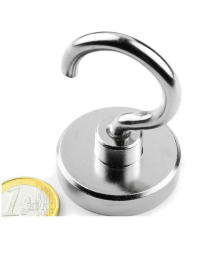
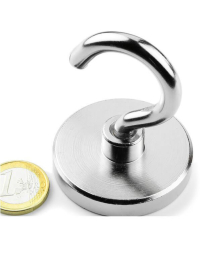
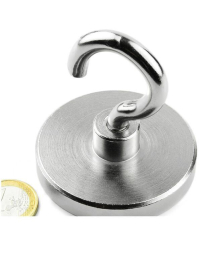
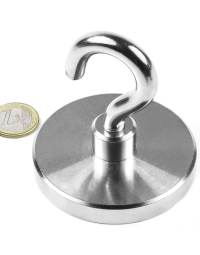
- Hook magnets have a hook, but since the hook is open, the rope can slip off and you lose the magnet. It is possible to put the hook in a vice to bend the hook until it closes.
- Hook eye magnets are quite popular as the eye is closed (unlike hook magnets) and therefore the rope cannot slip off.
- Regular neodymium magnets with a hole in the centre for rope attachment. The magnet is strong and magnetic on all sides, but must be handled with care as it is not protected by a steel pot.
- Pot magnets have no hook or hook eye and therefore need to be mounted on something else. This could be a plate or the end of a stick, for example. Multiple pot magnets can be mounted next to each other for greater strength.