
The type of magnet determines how much heat the magnet can withstand. For most neodymium magnets, the maximum temperature is 80 degrees, while for ferrite magnets it is 250 degrees. For very thin neodymium magnets with a thickness of 1-2 mm, the maximum temperature can be slightly lower, while larger neodymium magnets with a thickness of more than 10 mm can withstand temperatures up to 140 degrees.
In the following you can read in more detail what you need to know about magnets and heat. The article is about neodymium magnets and not other types such as ferrite, Alnico and others.
What is Curie temperature?
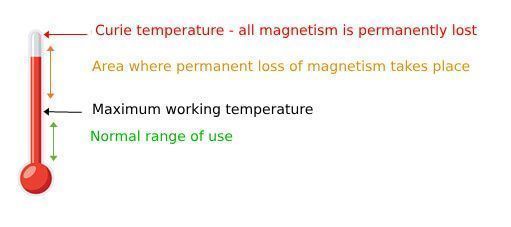
Curie temperature (CurieTemp) tells at what temperature a magnet permanently loses all its magnetization. This means that the magnetic field is gone and will not return upon cooling. Nor can the magnetic field be recreated by exposing the magnet to a strong electronic magnetic field. So the magnet is dead!
What is the Max Working Temperature?
The Max Working Temperature (MaxTemp) tells at what temperature a magnet starts to lose its magnetization. Permanent loss of magnetization is a smooth transition that starts at MaxTemp and ends at CurieTemp.
As the temperature gets closer and closer to MaxTemp, you may experience a temporary loss of magnetism, which is usually less than 10%. When the magnet cools down to room temperature, the magnet regains its full magnetism. Temperatures below MaxTemp are a temporary loss of magnetism, while temperatures above MaxTemp are where the smooth transition to a permanent loss of magnetism begins.
What does the size of the magnet mean for how much heat it can withstand?
As if that's not complex enough, shape and size also affect how much heat a magnet can withstand. Thin magnets have a slightly lower working temperature than “thick” magnets. So if you have a magnet with a thickness of 1 or 2 mm, you will find that the working temperature may be slightly lower than the official working temperature of 80 degrees.
What should I know about temperatures before buying a magnet?
Probably the most important thing to know is that increasing temperature can permanently demagnetize a neodymium magnet partially or completely. Therefore, you need to be careful in the following situations:
- Do not use hot glue on magnets
- Do not process magnets with tools. If processing does not destroy the magnet, the frictional resistance between tool and magnet will result in high temperatures
- Do not apply magnets to hot workpieces such as metal that has just been welded or sawn
- Do not use magnets in hot applications such as ovens, motors and lamps
- Avoid using neodymium magnets at temperatures higher than 80 degrees.
How do I know how high a temperature a magnet can withstand?
The most common MaxTemp is 80 degrees and the most common CurieTemp is 310 degrees. If a magnet can withstand higher temperatures than these, it is stated on the product pages. Alternatively, it can also be derived from the numbers and letters that indicate a magnet's magnetism. If a magnet has the letter type M after it (e.g. N42M), it has a MaxTemp of 100 degrees and a CurieTemp of 340 degrees. If it has the letters SH instead (N42SH), it has a MaxTemp of 150 degrees and a CurieTemp of 340 degrees.
The vast majority of our magnets are of the “N” type.
In the table below you can see the relationship between the types and temperatures.
Heat table for neodymium magnets
| Types of temperature | Max Working Temperature | Curie temperature |
| N | 80°C | 310°C |
| M | 100°C | 340°C |
| H | 120°C | 340°C |
| SH | 150°C | 340°C |
| UH | 180°C | 350°C |
| EH | 200°C | 350°C |
| UH | 230°C | 350°C |
*The heat chart covers most types, but there are exceptions. Magnets with quality grades N50 or N52 can withstand a maximum of 65 °C