
There are several different types of magnets, each with their own advantages and disadvantages. Two of the most common types are neodymium magnets and ferrite magnets. In the following we will look at the differences between the two types of magnets and when to choose one over the other.
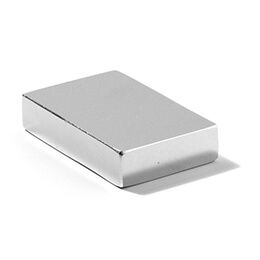
Neodymium magnets at a glance
Neodymium magnets are magnets that are known for their high strength. Although small, magnets are very powerful and are therefore useful in a wide range of products. You'll find them in electric motors, speakers, locking mechanisms, computers and pretty much anywhere where high magnetic strength is needed.
Neodymium magnets are produced through a process called sintering. In short, it's a process where a mixture of metals is pressed hard together under high heat until it becomes solid. The result is solid bars, which are then cut into smaller slices depending on how big the magnets need to be. An alloy is then added to the slices to protect against moisture. The alloy is often made of nickel. Finally, the magnets are exposed to an electric magnetic field that gives the magnets their magnetism.
Neodymium magnets have a relatively high cost due to the cost of extracting the metals needed to produce the magnets. In addition, the production of neodymium magnets is quite complex with many steps, each of which has a cost.
Disadvantages:
- Are relatively expensive
- Erode if exposed to sustained moisture/water
- Lose their magnetism at high temperatures
- Cannot withstand impact or shock
Advantages:
- Has a very strong magnetism
Ferrite magnets at a glance
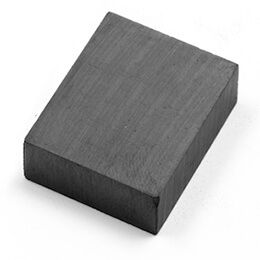
Like neodymium magnets, ferrite magnets are very popular magnets. Unlike neodymium magnets, they are cheap to buy, do not require a special alloy and are functional even at high temperatures. The disadvantage of ferrite magnets is that their strength is much lower than neodymium magnets. Often this is a disadvantage, but the low strength is sufficient for many applications. Therefore, ferrite magnets are used as fridge magnets, for speakers, electric motors and more.
Ferrite magnets are often produced by pressing magnetic powder hard together in a mold. Then magnets are sintered and finally it is possible to grind, cut or polish magnets to the desired shape and finish.
Disadvantages:
- Has a weak magnetism
Advantages:
- Are inexpensive
- Will not erode if exposed to moisture/water
- Withstands some impact or shock to a certain extent
Should I choose neodymium magnet or ferrite magnet?
The type of magnet you choose depends on the usage situation. Often you want a powerful magnet that is as small as possible. In these cases, neodymium magnets are the obvious choice. If you can make do with a weaker strength and a larger magnet, you can start looking at ferrite magnets. However, you should also consider things like working temperature, humidity tolerance and impact resistance in your decision. To simplify it a bit, the two types of magnets and their advantages and disadvantages can be presented in a chart like this:
| Price | Temperatur | Blows/impact | Moisture | Strength | |
|---|---|---|---|---|---|
| Neodymium magnets | Expensive | Standard is max 80 degrees | Cannot withstand impact | Cannot withstand prolonged moisture | Very powerful |
| Ferritmagneter | Cheap | Standard is max 250 degrees | Can withstand a bit of impact | Moisture tolerant | Not very powerful |
From the chart, hopefully you can assess which type of magnet works best for your application. If we look at what our customers tend to choose, in 95% of all cases it is a neodymium magnet. The very high magnetic strength often justifies the higher price. If you are still in doubt, you are always welcome to contact us at info@brisingi.com with any questions.