
Neodymium magnets, known for their remarkable strength, find application in a wide range of scenarios, from everyday items to complex machinery. However, several factors can influence the strength and adhesive force of magnets:
Factors that affect magnet strength
Quality grades
Magnets are classified based on their strength. You may see magnets labelled as N35, N42 or N52, where the number indicates the strength. Higher numbers generally indicate stronger magnets. For example, an N52 magnet is stronger than an N35 magnet. If you have two magnets of the same size, the magnet with the higher quality grade will have the higher strength.
Size and Shape of the Magnet
Size can also affect strength. Larger magnets usually have stronger magnetic fields. This means that if you have two magnets that have the same quality grade, the larger of the two magnets will typically be the stronger. The shape of the magnet also affects its strength, with thicker magnets often producing stronger magnetic fields than thin magnets. Therefore, if you need a very strong magnet, you will often end up with a magnet that has a high quality grade, is as large as possible and is not very thin.
Contact surface and quality of contact
En magnets styrke bestemmes ikke kun af dens størrelse, men også af kontaktfladens kvalitet og størrelse. For at magneten skal fungere optimalt, skal hele magneten være i kontakt med en kontaktflade, og kontaktfladen skal være lidt større end magneten. Det er vigtigt at bemærke, at hvis magneten eller den overflade, den er fastgjort til, er snavset, ujævn eller har buler eller ridser, kan magnetens evne til at hæfte ordentligt blive kompromitteret. Hvis du sørger for, at overfladen er ren, og at magneten er placeret fladt, kan det forbedre vedhæftningen betydeligt.
Metal type and thickness of contact surface
The metal type of the contact surface and the thickness of the surface are also factors to consider. Magnets stick best to metals that contain iron, steel or other ferromagnetic materials. Metals such as aluminium, copper, stainless steel or brass do not attract magnets very well because they are not ferromagnetic. The thickness of the metal is also important as a thin contact surface cannot absorb the bright magnetic field. For optimal strength, the contact surface should have a thickness of at least 2 mm and sometimes up to 20 mm. It depends on the strength of the magnet.
Distance Between the Magnet and the Contact Surface
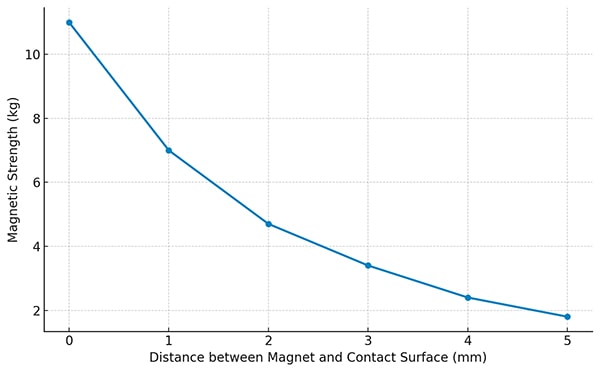
The distance between the magnet and the contact surface is also important. Even a small distance (0.1 mm) can significantly reduce the strength of the magnet, so it's best to avoid it if possible. When the magnet touches the surface directly, the attraction is strongest. Even a very strong magnet quickly becomes weak when there is no direct contact.
Temperature
Temperature is another important factor that affects magnet strength. For example, neodymium magnets work best in cooler environments and if they heat up too much, they can lose some of their strength and sometimes this loss of strength can be permanent. If magnets get too hot, their magnetic force weakens and they don't regain their full strength even when they have cooled down again. Neodymium magnets should therefore not be exposed to temperatures higher than their maximum working temperature and Curie temperature. These figures are written on each product page.
Direction of Force
It's also worth bearing in mind the direction of the force applied to the magnet, as magnets perform best when the force pulling on them is directly away from the surface (perpendicular). If you try to push the magnet to the side or pull it at an angle, you may find that the magnet slides off the contact surface.
How to Get the Most from Your Magnet
To get the most out of your neodymium magnets, you may find it helpful to remember the following tips:
- A high quality grade performs better than a lower quality grade
- It is recommended that you make sure the magnet and contact surface are clean and smooth.
- Use a contact surface that is as thick as possible.
- It is advisable to keep your magnets cool, and avoid exposing them to heat.
- It is best to avoid gaps between your magnet and the surface.
- Finally, if you want maximum strength, it is best to pull straight out (perpendicular to the surface).