
Short answer: Even a 0.5–1 mm gap can reduce a magnet’s pull force dramatically. At around 2 mm distance, many smaller magnets have lost roughly half (or more) of their pull force, and at 5–10 mm distance they’re often effectively unusable unless the magnet is thick/large and the steel is substantial. The exact loss depends mainly on the magnet’s size, thickness, grade, and the thickness/quality of the steel surface.
We sometimes get questions like this:
“I bought a magnet rated for 10 kg, but it can barely hold itself.”
In normal conditions, a magnet can easily hold its own weight—and with a 10 kg pull-force rating it should stick very well to a steel plate. There can be several different factors involved, but in this case the magnet does not have direct contact with the steel. There is a small gap.
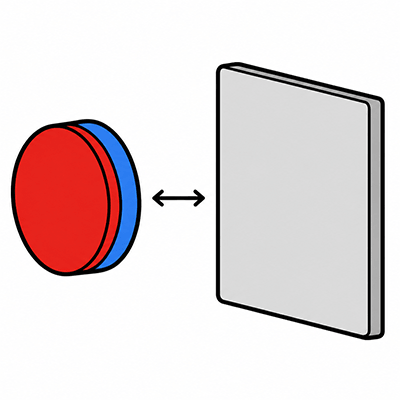
For example, the customer may be building a DIY wooden notice-board magnet. They drill a hole in a piece of wood and place the magnet inside. To hide the magnet, the hole doesn’t go all the way through—leaving a 10 mm distance between the magnet and the steel surface it needs to stick to.
10 mm doesn’t sound like much, so the customer contacts us asking why a “strong” magnet doesn’t work. The answer is that 10 mm is a very large gap in magnet terms. Even a small gap of just 0.5 mm can reduce pull force noticeably.
Why does pull force drop with distance?
When a magnet’s pull force is stated in kg, it is typically measured with direct contact to a thick, flat steel plate and in a straight pull-off test. As soon as you add distance between the magnet and the steel—for example wood, glass, fabric, paint, tape, air, or paper—the pull force drops sharply.
And if the magnet must hold something on a vertical surface, you’re usually fighting shear (sliding) and sometimes peel/torque. That’s why real-world performance on a wall can be much lower than the pull-off rating—and why you often need a stronger magnet (or a rubber-coated magnet for more friction).
There’s no way to “fix” the fact that magnets lose strength with distance. All magnets drop quickly over the first few millimeters and then decrease more slowly.
Instead of trying to solve the impossible, you work around it. You can do three things:
-
Reduce the gap as much as possible.
Every millimeter hurts performance. Each time you can reduce the distance by even half a millimeter, the magnet will hold better. -
Choose a stronger magnet.
If you can’t reduce the gap, choose a magnet that is stronger than you would need with direct contact. You can use our strength calculator to estimate pull force at different distances. -
Consider whether magnets are the best solution.
If the distance is too large, magnets may not be the right approach. Consider alternatives such as suction cups, screws, glue, or tape.
How much pull force is lost with distance? Examples
For a typical neodymium magnet against a steel plate, the loss often looks roughly like this:
| Distance | Pull-force loss |
|---|---|
| 0.5 mm | 10–30% |
| 1 mm | 20–50% |
| 2 mm | 40–70% |
| 5 mm | 65–90% |
| 10 mm | 80–100% |
So even at just 1 mm, the magnet may already have lost up to half of its pull force.
How much does magnet size affect distance loss?
A simple rule of thumb is that a thicker magnet performs better at a distance than a thin magnet. This can be true even if both magnets have the same stated pull force when they are in direct contact with a steel plate.
Below are three groups of magnets with different thicknesses. This illustrates how thickness is a major factor in how a magnet’s pull force falls off with distance.
| Magnet group | Example dimensions |
|---|---|
| Small | Approx. 2 mm thick, e.g. a 10×2 mm disc magnet |
| Medium | Approx. 5 mm thick, e.g. a 20×5 mm disc magnet |
| Large | Approx. 10 mm thick, e.g. a 30×10 mm disc magnet |
And the loss can look roughly like this:
| Distance | Small magnet | Medium magnet | Large magnet |
|---|---|---|---|
| 0.5 mm | 50% lost | 25% lost | 15% lost |
| 1.0 mm | 70% lost | 40% lost | 25% lost |
| 1.5 mm | 80% lost | 55% lost | 35% lost |
| 2.0 mm | 85% lost | 65% lost | 40% lost |
| 2.5 mm | 90% lost | 70% lost | 50% lost |
| 3.0 mm | 95% lost / negligible in practice | 75% lost | 55% lost |
| 3.5 mm | 95% lost / negligible in practice | 80% lost | 60% lost |
| 4.0 mm | 95% lost / negligible in practice | 85% lost | 65% lost |
| 4.5 mm | 95% lost / negligible in practice | 85% lost | 65% lost |
| 5.0 mm | Effectively unusable | 85% lost | 70% lost |
| 5.5 mm | Effectively unusable | 90% lost | 75% lost |
| 6.0 mm | Effectively unusable | 90% lost | 75% lost |
| 6.5 mm | Effectively unusable | 90% lost | 80% lost |
| 7.0 mm | Effectively unusable | 95% lost / negligible in practice | 80% lost |
| 7.5 mm | Effectively unusable | 95% lost / negligible in practice | 80% lost |
| 8.0 mm | Effectively unusable | 95% lost / negligible in practice | 85% lost |
| 8.5 mm | Effectively unusable | 95% lost / negligible in practice | 85% lost |
| 9.0 mm | Effectively unusable | 95% lost / negligible in practice | 85% lost |
| 9.5 mm | Effectively unusable | 95% lost / negligible in practice | 85% lost |
| 10.0 mm | Effectively unusable | 95% lost / negligible in practice | 85% lost |
From the table you can see that a magnet up to about 2 mm thick is almost useless at a 3–5 mm gap. If the magnet is 5 mm thick, it has lost most of its pull force around 7 mm. The large magnet (about 10 mm thick) can still retain a bit of pull force even at 10 mm distance.
Important notes
Please note that the tables are generalizations and real magnets may behave slightly differently. Actual pull force depends on the magnet’s grade (for example N35 vs. N52), the steel plate’s thickness and quality, and how flat the surfaces are.
If the magnet is used for something critical, you should always verify the specific magnet. You can do that on the product pages or by using a magnet calculator.
So which magnet should you choose?
The stated pull force on product pages is measured with direct contact between magnet and steel. Always consider what sits between the magnet and the metal. Paint, foil, tablecloths, lacquer, tape, air, and stickers all count as distance.
If there is any gap at all, it is often better to choose a thicker magnet rather than a wider (but thin) magnet.
Frequently asked questions about magnets and distance
How much strength does a magnet lose at 1 mm distance?
At a 1 mm gap, a magnet can often lose 20–50% of its pull force, depending on the magnet’s size, thickness, and grade.
Why doesn’t my 10 kg magnet work through wood?
Because the 10 kg rating is usually measured with direct contact to steel. If wood sits between the magnet and the steel, the pull force drops sharply.
Do paint, tape, and foil count as distance?
Yes. Everything between the magnet and the steel surface counts as distance—including paint, tape, foil, lacquer, paper, fabric, and air.
Is a thicker magnet better at a distance?
Often, yes. A thicker magnet handles distance better than a very thin magnet, even if they have the same stated pull force at direct contact.
Can a magnet work through glass?
Yes, but glass creates distance. That’s why glass boards and glass mounting typically require significantly stronger magnets.